Gigabit Ethernet is available for copper and fibre optic interfaces. It further increases the speed of the Ethernet protocol, offering a tenfold speed increase over Fast Ethernet to 1 gigabit per second (Gbps).
Gigabit Ethernet utilises five levels and 8b/10b encoding, to provide even more efficient use of the limited cable bandwidth, sending 1 Gbps within approx 100 MHz of bandwidth (i.e. the capacity of a UTP Cat5e cable.
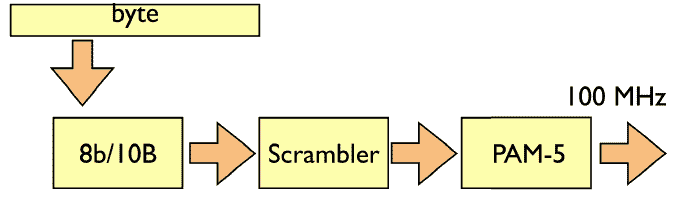
It utilises five levels and 8b/10b encoding, that is scrambled and converted into a physical layer signal to provide even more efficient encoding of the clock information. 8b/10b encoding assigns each byte of data to a 10 bit code. Each byte is split into the 3 most significant bits and the 5 least significant bits. It is then represented as two decimal numbers with the least significant bits first e.g. for the octet 101 00110 the result is the decimal 6.5. 10 bits are used to create this code and the naming convention follows the format /D6.5/. There are also 12 special codes which follow the naming convention /Kx.y/.
The 10 bit code must contain either five ones and five zeros, or four ones and six zeros, or six ones and four zeros. This prevents a sequence of too many consecutive ones and zeros, assisting clock synchronisation. Two 'commas' are used to aid in bit synchronisation, these 'commas' are the 7 bit patterns 0011111 (+comma) and 1100000 (-comma).
To maintain a DC balance, a calculation called the Running Disparity calculation is used to keep the number of '0's transmitted the same as the number of '1's transmitted. The method uses 10 bits to represent each 8 bits of data (byte) and therefore increases the rate required to send the data.
The interface encodes the 10 bit code after it is scrambled and converts it into a physical layer signal by mapping pairs of bits using a 5-level Pulse-Amplitude-Modulation (PAM). This sends a group of bits as one of five signal levels, i.e.one of ({+2, +1, 0, -1, -2}.
For UTP, a 1 Gbps the line speed results in a transmission rate of 10/8 x 1 = 1.25 Gbps. In Gigabit Ethernet this rate is then reduced mapping pairs of bits using a 5-level Pulse-Amplitude-Modulation (PAM). (With less bandwidth than possible with a 3-level code). Gigabit Ethernet can therefore more efficient use of limited UTP cable bandwidth, sending 1 Gbps within approx 100-125 MHz of bandwidth (i.e. the capacity of a UTP CAT5e cable). In comparison, the original 10 Mbps Ethernet used Manchester encoding, while Fast Ethernet (at 100 Mbps) used a 4b/5b MLT code.
A 10/100/1000 NIC also automatically senses the speed of the attached segment. It usual to support only UTP Cat5e or CAT6 cables on NICs using Gigabit Ethernet (CAT-5 cables may also work over shorter distances). Server versions of the NICs typically support much higher packet rates than PC interfaces and can sometimes support VLANs at the server.
Many managed Etherent switches provdie a small number of fibre interfaces together with their copper interfaces using 10/100/1000BT.
Gigabit Ethernet can be used over fibre cables by using one of the various forms of GBIC - Gigabit Interfaces. e.g. 1000B-SX uses multimode fibre for connections within a building (up to 500m), and 1000-LX use single mode fibre to reach longer distances, and LH extends the reach of single mode fibre to 10s of kilometers. Many managed Etherent switches provdie a small numebr of fibre interfaces together with their copper interfaces using 10/100/1000BT.
For more information see: